
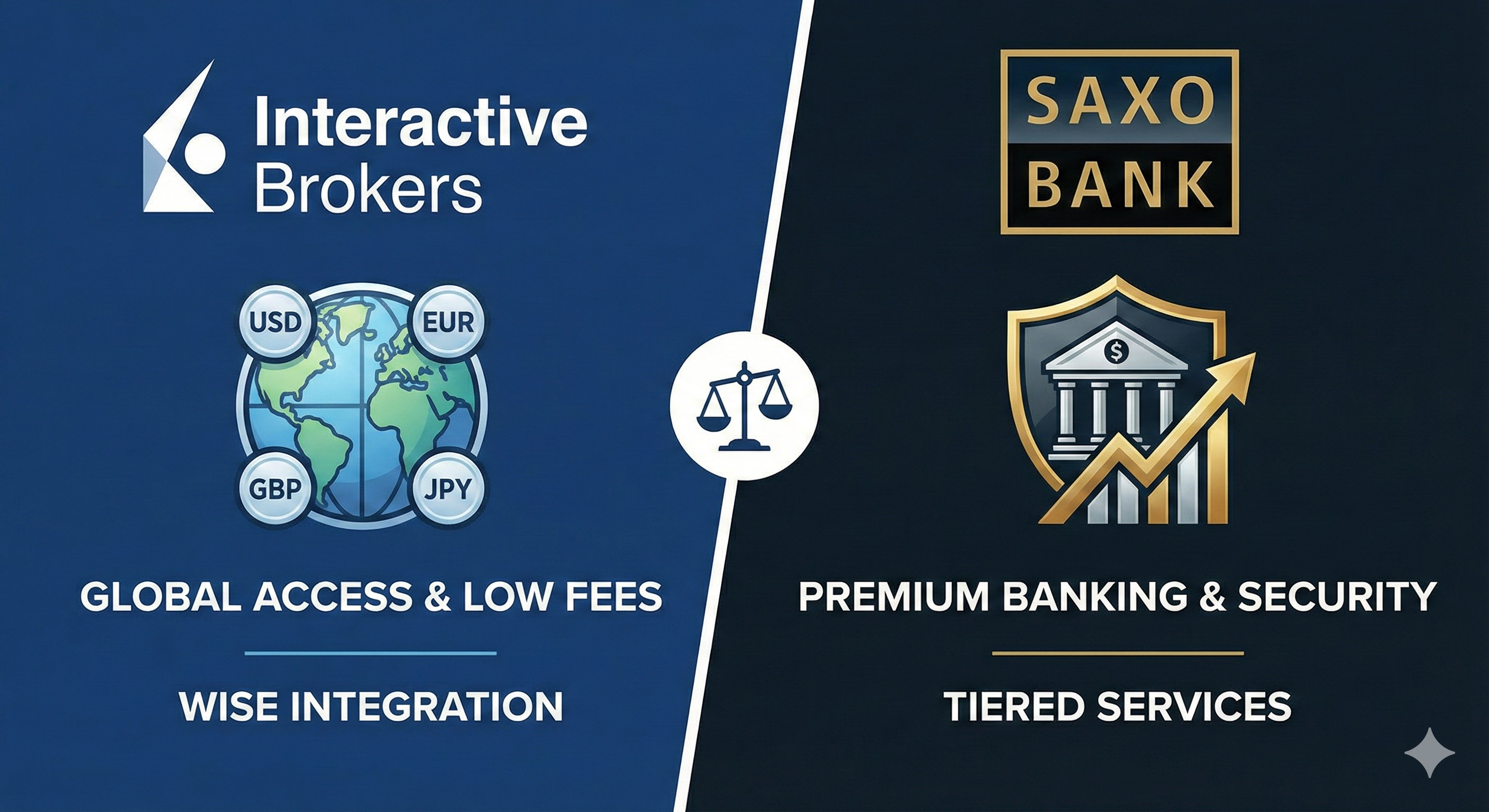
The landscape of international investing has undergone a seismic shift. In 2026, the barriers to global markets have thinned, yet the complexity of managing wealth across multiple jurisdictions has never been higher. For the remote professional—the individual earning in one currency, living in another, and planning for a future in a third—choosing a brokerage is the most critical financial decision of their career.
Two names consistently dominate the conversation: Interactive Brokers (IBKR) and Saxo Bank. Both offer gateways to the world’s exchanges, but they represent two fundamentally different philosophies of wealth management.
In this exhaustive 2.000-word review, we will dissect every layer of these platforms—from regulatory frameworks and hidden fee structures to platform ergonomics and nomad-specific hurdles.
1. The Institutional Pedigree: Who Are You Trusting?
Before discussing pips and commissions, we must discuss solvency and safety. When you hold assets offshore, you are betting on the regulatory stability of the broker’s home jurisdiction and their corporate health.
Interactive Brokers: The Automation Powerhouse
Founded by Thomas Peterffy, IBKR was built on the principle of extreme automation. Today, it is a publicly-traded US company (NASDAQ: IBKR) with equity capital exceeding $14 billion. Its philosophy is “high volume, low margin.”
- Regulatory Shield: Depending on your residency, you may be under the US SEC/FINRA (offering SIPC protection up to $500,000), IB UK (regulated by the FCA), or IB Ireland/Hungary (Central Bank of Ireland/MNB).
- The “Engine” Mentality: IBKR acts as the backend for thousands of other smaller brokers. It is essentially the “plumbing” of the global financial system.
Saxo Bank: The Danish Banking Heritage
Saxo Bank is not just a broker; it is a licensed Danish bank. This is a crucial distinction. Being a bank subject to European Banking Union regulations means it faces more stringent reporting and capital requirement rules than a pure-play brokerage.
- Regulatory Shield: Regulated by the Danish Financial Supervisory Authority (FSA). Under the Danish Guarantee Fund, cash deposits are generally protected up to €100,000.
- The “Boutique” Mentality: Saxo positions itself as a premium service provider. It’s less about being a “utility” and more about being a “partner.”
2. Fee Structures: A Granular Dissection
In 2026, “zero-commission” is a marketing gimmick for retail apps. Serious investors know that the real costs lie in spreads, custody fees, and currency conversion.
Interactive Brokers: The Mathematical Winner
IBKR’s fee structure is famously complex because it is transparent. They offer two main models: Fixed and Tiered.
- Tiered Pricing: Ideal for the remote professional who trades smaller amounts frequently. You pay the exchange fees plus a tiny broker commission.
- Custody Fees: Zero. IBKR famously eliminated inactivity fees in 2021 and has kept them at zero, making it perfect for “buy and hold” investors.
- Currency Conversion: This is IBKR’s “Killer Feature.” They charge a razor-thin spread (0.03 basis points) with a minimum of $2. If you are converting $50,000 from USD to EUR to buy an Irish-domiciled ETF, IBKR will save you hundreds compared to traditional banks.
Saxo Bank: The Price of Elegance
Saxo historically was expensive, but they pivoted in 2024 and 2025 to a tiered membership model: Classic, Platinum, and VIP.
- The Thresholds: To get competitive rates, you need to move up the tiers. The “Classic” tier still carries higher commissions than IBKR.
- Custody Fees: This is the deal-breaker for many. Saxo often charges a custody fee (e.g., 0.12% to 0.25% per annum). While this sounds small, on a $1M portfolio, you are paying **$1,200 to $2,500 a year just to let your stocks sit there.**
- FX Conversion: Saxo charges a standard 0.25% FX mark-up. On the same $50,000 conversion mentioned above, Saxo would charge you roughly $125, whereas IBKR would charge $2.
3. Market Access: The “Everything” Store vs. The “Curated” Store
For a global citizen, access to the US market is a given. But what about the LSE (London), the HKEX (Hong Kong), or the EUREX (Europe)?
The IBKR Inventory
IBKR offers access to 150 markets in 33 countries. This includes:
- Stocks and ETFs: Global coverage.
- Options and Futures: The gold standard platform for derivative traders.
- Fixed Income: A massive bond desk that allows retail investors to buy US Treasuries and corporate bonds directly.
- Fractional Shares: Crucial for those dollar-cost averaging into expensive stocks like Berkshire Hathaway or high-priced ETFs.
The Saxo Inventory
Saxo offers access to over 71,000 instruments. While slightly fewer markets than IBKR, they cover all the essentials for 99% of investors.
- Mutual Funds: Saxo has a better “user-friendly” interface for browsing international mutual funds.
- Bonds: Very strong bond offering, presented in a way that is much easier for a non-professional to understand than IBKR’s interface.
4. Platform Experience: UX vs. Utility

IBKR: From “clunky” to “cutting-edge”
For years, the critique of IBKR was its 1990s-style interface. In 2026, that has changed.
- IBKR Desktop: A new, streamlined application that bridges the gap between the complex TWS (Trader Workstation) and the simple mobile app.
- GlobalTrader App: A mobile-first experience that is as easy to use as Robinhood but with the power of a global broker.
- The Learning Curve: Still exists. IBKR assumes you know what you are doing. If you make a mistake, their automated system will liquidate your position without a phone call to “save” the broker’s margin.
Saxo: The Gold Standard of Design
SaxoTraderGO (web/mobile) and SaxoTraderPRO (desktop) are masterpieces of financial engineering.
- Visualization: Saxo provides incredible visual breakdowns of your portfolio’s geographic and sector exposure.
- Research: Their integrated research (Saxo Strats) provides high-quality daily macro analysis that feels like a premium subscription service.
- Support: Saxo’s customer support is generally more “human” and responsive than IBKR’s, which relies heavily on a ticket-based system.
5. The Nomad’s Dilemma: Residency and Compliance
This is where the rubber meets the road for our audience. Most brokers hate nomads. They want a fixed utility bill and a permanent tax ID.
Handling Address Changes
- Interactive Brokers: They are the most flexible. If you move from Brazil to Portugal, you simply update your tax residency in the portal. IBKR will often “migrate” your account between their legal entities (e.g., from IB LLC to IB IE) behind the scenes.
- Saxo Bank: More rigid. Saxo has a list of “prohibited countries” that is often longer than IBKR’s. If you move to a country on their “unsupported” list, they may give you 30 days to close your account.
Funding and Withdrawals
- The Wise Integration: IBKR has a native integration with Wise. You can see your Wise balance inside the IBKR app and pull funds instantly. This is a game-changer for people earning in multiple currencies.
- Saxo Bank: Relies on traditional SWIFT transfers. While reliable, it is slower and subject to the intermediary bank fees that nomad professionals try to avoid.
6. Advanced Strategy: Yield on Cash and Margin
In a high-interest-rate environment (like 2024-2026), where you leave your “dry powder” (cash) matters.
- IBKR: They currently pay market-leading interest rates on idle cash balances (up to 4.83% on USD for balances over $10k, depending on the tier). They also have a “Stock Yield Enhancement Program” where they share 50% of the revenue earned from lending out your shares to short-sellers.
- Saxo Bank: They also pay interest on cash, but the tiers are less favorable for smaller accounts. You typically need a much larger balance to start seeing meaningful interest.
7. Tax Efficiency: The “Irish ETF” Factor
For non-US residents, investing in US-domiciled ETFs (like VOO or QQQ) is often a tax mistake due to the 30% withholding tax on dividends and the US Estate Tax (which hits non-residents on assets over $60,000).
- IBKR: Makes it incredibly easy to buy UCITS ETFs (domiciled in Ireland). These ETFs reduce the dividend withholding tax to 15% and remove the US Estate Tax risk entirely.
- Saxo Bank: Also offers access to these, but their search engine often defaults to the local or more expensive versions. You have to be more diligent in your ticker selection.
The 2026 Verdict: Which One Wins?
The Case for Interactive Brokers (The “Winner” for Most)
If you are a remote professional looking to build long-term wealth with the lowest possible drag on your returns, Interactive Brokers is the undisputed winner. The combination of zero custody fees, near-spot FX rates, and Wise integration makes it the perfect “financial engine” for a global life. It is a platform you can grow into, from your first $10,000 to your first $10,000,000.
The Case for Saxo Bank
Choose Saxo Bank if you have a portfolio exceeding $500,000, you value high-touch human support, and you want a “beautiful” interface that makes managing money feel like a luxury experience rather than a technical task. It is for the investor who doesn’t mind paying a 0.12% premium for a “Danish Private Banking” feel.
Your Next Steps in Global Wealth Management
Selecting your broker is step one. Step two is ensuring your Tax Residency is optimized so you aren’t handing over your gains to a government you don’t even live in.
- Action 1: Open an account with Interactive Brokers (their Lite or Pro version depending on your frequency).
- Action 2: Link your Wise or Revolut Business account for seamless funding.
- Action 3: Read our Pillar Guide on International Tax Residency to ensure your “Flag Theory” strategy is airtight.